

Over the past several weeks, I’ve been reading articles about attorney turnover, burnout, AI adoption, succession planning, profitability, hiring challenges, and operational efficiency. At first glance, they appear to be discussing completely different issues. One article focuses on retaining associates. Another discusses artificial intelligence. A third examines succession planning. Others explore technology, leadership, delegation, growth, and culture.
Yet the more I read, the more I find myself coming back to the same conclusion: law firms don’t have an effort problem. They have an architecture problem. What’s interesting is that experts from completely different disciplines are beginning to arrive at similar conclusions. Technology consultants are talking about process design. Leadership coaches are discussing organizational architecture. Hiring experts are focused on culture and development. Succession advisors are talking about systems and continuity. Everyone seems to be reaching the same realization: the visible problem is rarely the actual problem.
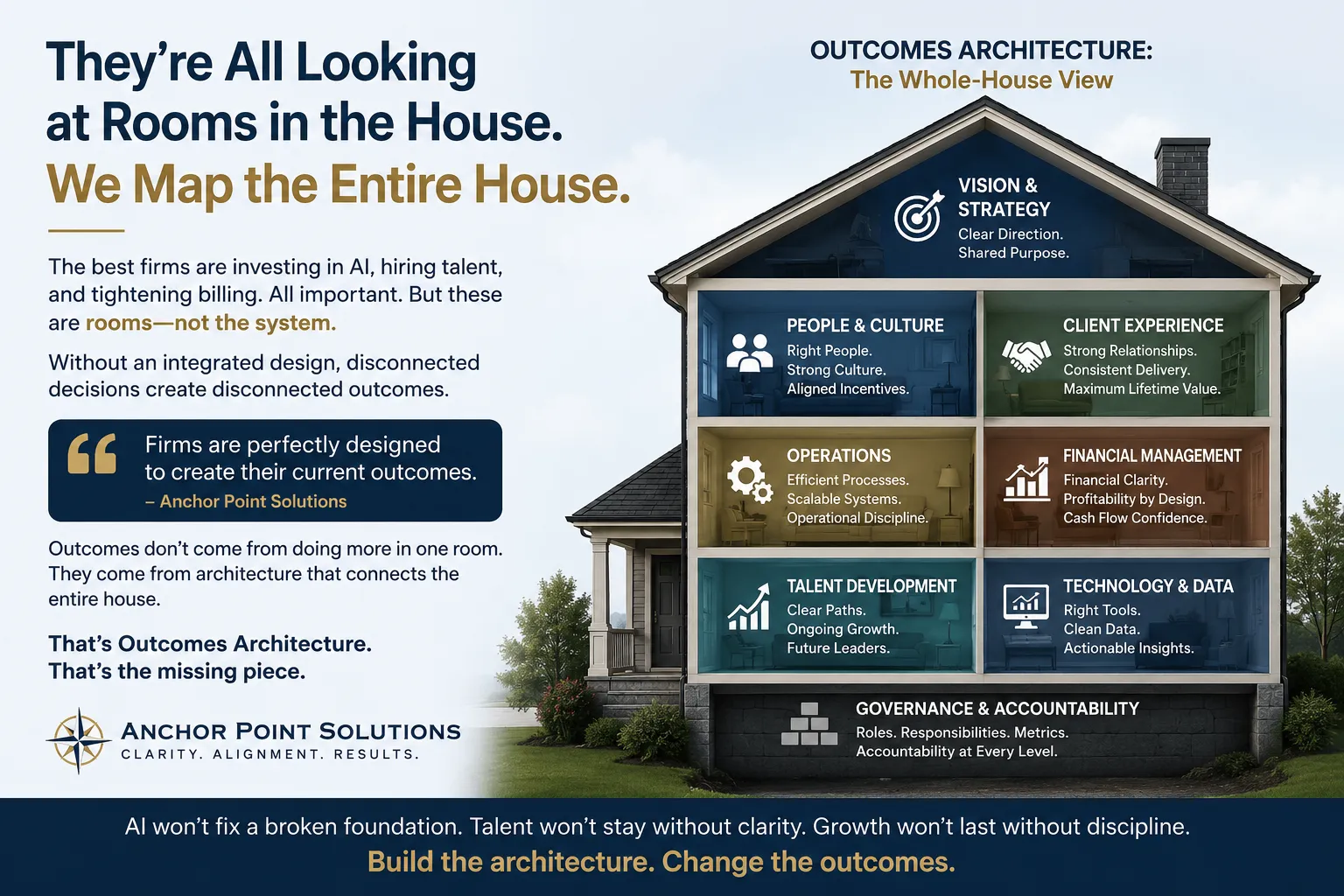
One of the principles we often discuss at Anchor Point is that organizations are perfectly designed to create their current outcomes. That statement can be uncomfortable because it forces us to look beyond symptoms and examine the systems underneath them. When a firm struggles with turnover, there is usually a reason. When partners feel overwhelmed, there is usually a reason. When growth creates stress instead of opportunity, there is usually a reason. When profitability remains inconsistent despite strong revenue, there is usually a reason.
The outcome may not be intentional, but it is rarely accidental. The system is producing exactly what it was designed to produce. Too often, organizations respond by simply working harder. Partners bill more hours. Administrators take on additional responsibilities. Staff absorb more work. New software is implemented. Another process is added. Another meeting is scheduled. Sometimes that works for a while. Eventually it doesn’t. More effort can temporarily compensate for weak systems, but it cannot permanently fix them.
I often think about this using a house as an example. Imagine a group of specialists walking through a home. One notices a leak in the dining room ceiling. Another points out a crack in a wall. A third identifies an electrical issue in the kitchen. Every one of them is correct, and every issue deserves attention.
The problem is that none of them are looking at the house. They’re looking at rooms.
The homeowner doesn’t live in a room. The homeowner lives in the house. To truly understand what’s happening, you have to step back and ask bigger questions. Where is the water coming from? Why is the foundation shifting? Are these problems connected? Is the leak causing the crack? Is moisture creating electrical issues? The visible symptom is rarely the whole story.
I see the same thing happen in law firms every day. A turnover issue becomes an HR discussion. A profitability issue becomes a financial discussion. A technology issue becomes a software discussion. A succession issue becomes a partner discussion. Each conversation focuses on a room. Very few focus on the house.
Take associate turnover as an example. Many firms immediately focus on recruiting when an associate leaves. Recruiting may eventually be part of the solution, but it is often not the problem. The real issue may be unclear career paths, inconsistent mentorship, poor delegation, capacity constraints, lack of leadership development, or a culture that unintentionally discourages growth.
The resignation is not the problem. The resignation is the indicator.
The same can be said for profitability, burnout, client service challenges, missed deadlines, and operational inefficiencies. What appears to be a single issue is often multiple systems interacting beneath the surface. That is why so many firms find themselves solving the same problems over and over again. The symptoms change, but the underlying architecture remains the same.
Finding the system responsible for the outcome is an important step, but it is only the first step. Many organizations stop there. They identify the cause and assume the work is complete.
It isn’t.
Once you identify the system producing the outcome, the next question becomes even more important: What should this system be producing?
If your associate development system is producing turnover, your leadership system is producing burnout, or your revenue system is producing inconsistent profitability, the goal isn’t simply to understand the cause. The goal is to define the desired outcome and intentionally redesign the system to produce it.
That is where meaningful improvement begins.
The firms that thrive over the next decade will not necessarily be the firms with the newest technology or the largest marketing budgets. They will be the firms that understand how their systems work together. More importantly, they will be the firms that intentionally align those systems with the outcomes they want to create.
bold textBecause organizations are perfectly designed to create their current outcomes.**