

A managing partner calls. She has just lost her third associate in eighteen months. Each departure followed the same pattern: a promising hire, a difficult first year, a resignation letter that cited “lack of direction” or “unclear expectations” or simply “a better opportunity.” Each time, the firm’s response was the same — post the position, interview candidates, make an offer, start over.
She is not asking the wrong question. She is asking an incomplete one.
The question is not “How do we find better people?” The question is “Why does this keep happening to the people we hire?”
The Industry Keeps Diagnosing Symptoms
Legal industry research published over the past several weeks has surfaced a consistent set of concerns. New hires often require so much supervision that firms experience little or no net capacity gain. Associates leave because of poor career development, inadequate mentoring, and uncertainty about their future. Institutional knowledge remains trapped inside long-tenured employees, creating significant succession risk when those employees retire. Attorneys report feeling disconnected from firm leadership, culture, and organizational mission.
At first glance, these appear to be separate problems requiring separate solutions. Most firms treat them that way — addressing each challenge individually as it surfaces, responding to turnover with a new hire, to capacity strain with additional staff, to a retirement with a replacement search.
What if they are all pointing to the same underlying cause?
Looking Beyond the Symptom
When a law firm experiences turnover, the natural response is “We need to hire better people.” When associates leave, it becomes “We need to pay more.” When capacity becomes strained, it is “We need more staff.” When a key employee retires, it is “We need a replacement.”
Each of those responses may be partially correct. None of them asks the more important question.
Not “How do we replace the person?” but “What conditions allowed that person to be successful in the first place — and are those conditions actually present in our firm?”
Those are very different challenges. And the answer to the second question determines whether the first question ever stops recurring.
The Hidden Challenge: Organizational Architecture
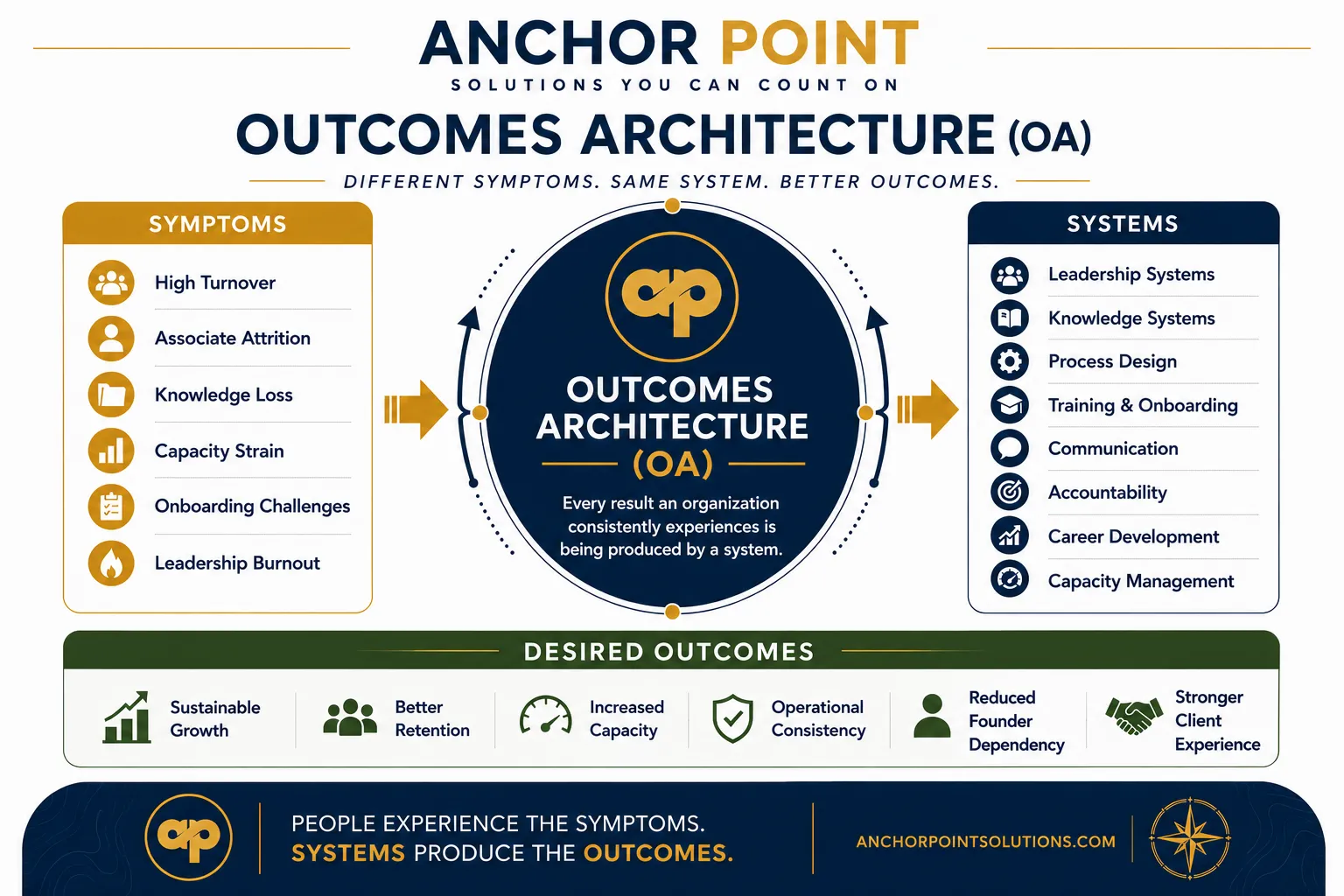
At Anchor Point, we work with law firms through a framework called Outcomes Architecture. The premise is straightforward: every result an organization consistently experiences is being produced by a system. Turnover is not simply a people problem. Retention is not simply a compensation problem. Succession is not simply a retirement problem. Capacity is not simply a staffing problem. They are outputs of the organization’s underlying architecture.
That architecture includes leadership systems, communication systems, knowledge systems, training and onboarding systems, career development pathways, process design, accountability structures, and organizational culture. When those systems are strong, organizations become resilient — able to absorb departures, integrate new people, and maintain performance continuity. When those systems are weak, organizations become dependent on individual employees to compensate for what the systems are not doing.
Consider what this looks like in practice. A firm promotes a senior associate to junior partner. She is talented, hardworking, and well-regarded by clients. Within six months, two of her direct reports have resigned. The firm’s instinct is to question the new partner’s management skills. But when we examine the situation more closely, we find that the firm has no documented onboarding process, no defined expectations for associate performance, no structured feedback cadence, and no clear pathway for advancement. The new partner is not failing because she lacks ability. She is failing because she was placed in a leadership role without the systems that would allow her — or anyone — to succeed in it. The firm built a position. It never built the infrastructure around the position.
This is the organizational architecture problem. And it is far more common than most managing partners realize.
Why Great People Still Struggle
One of the most persistent misconceptions we encounter is the belief that hiring the right person solves the problem. Great employees can absolutely improve an organization. But even exceptional people struggle when they enter environments with undefined expectations, inconsistent onboarding, limited mentoring, undocumented processes, unclear career paths, and poor communication from leadership.
The legal industry spends considerable energy searching for the “right person.” Operationally, the more productive question is whether the firm has built an environment where the right person can actually become successful. Hiring well matters. But hiring well into a broken system produces predictable results — and they are not good ones.
Institutional Knowledge Is an Organizational Asset, Not a Personal One
Many law firms possess tremendous institutional knowledge. The problem is that this knowledge lives inside individual employees rather than inside the organization itself.
Experienced legal assistants know the filing nuances that keep matters moving. Paralegals understand the carrier requirements that prevent billing disputes. Operations professionals know how work actually moves through the firm — which shortcuts exist, which exceptions are normal, which clients require special handling. Long-tenured employees frequently carry knowledge that never appears in a job description and was never written down anywhere.
The risk is not simply retirement. It is any event — a sudden departure, a health crisis, a better offer — that causes that knowledge to leave the organization without warning. Firms that fail to capture and transfer institutional knowledge find themselves repeatedly solving the same problems, rebuilding the same understanding, and absorbing the same costs every time a key person walks out the door.
The Massachusetts Lawyers Weekly recently made this point with particular clarity, noting that the “silver tsunami” of retiring professionals extends well beyond senior partners to the paralegals, finance staff, and operations managers who quietly hold the firm together. Their departure is not a succession planning problem. It is an organizational architecture problem — one that begins to be solved the moment a firm decides to treat its institutional knowledge as an asset worth protecting rather than a benefit of tenure.
Leadership Is the Ultimate Retention Tool — But Only When It Is Designed That Way
One theme appears consistently across recent legal industry research on retention: people stay where they feel invested in. Compensation matters, but compensation alone rarely creates loyalty. What attorneys and staff actually want is clear expectations, meaningful feedback, professional development, mentorship, visibility into their future, and confidence that leadership is genuinely invested in their success.
These are not HR initiatives. They are leadership systems. And leadership systems can be designed intentionally.
The firms that retain talent most effectively do not simply have good leaders — they have built the structures that allow good leadership to happen consistently. Regular one-on-one conversations are not left to individual managers’ discretion; they are built into the operating rhythm of the firm. Career development plans are not created ad hoc when someone threatens to leave; they are part of the onboarding process. Feedback is not delivered annually in a performance review; it is embedded in how work is supervised and reviewed every week.
When those structures exist, retention improves — not because the firm got lucky with its hires, but because the firm built conditions where talented people can see a future worth staying for.
Moving Toward the Desired Outcome
Anchor Point’s Outcomes Architecture work begins with a question that most operational engagements skip: What is the firm’s desired outcome?
The answer is different for every organization. Some firms want sustainable growth. Others want to build a destination firm for top legal talent. Some want to reduce founder dependency and create a business that can operate without the managing partner in every decision. Others want greater operational consistency — the confidence that client service is not varying based on which attorney or staff member happens to be available.
Once the desired outcome is defined, the focus shifts from solving isolated problems to designing systems that consistently move the organization toward that outcome. This is where most firms struggle. Identifying the problem is relatively easy. Designing and implementing systems that solve the problem while advancing the firm’s long-term goals is significantly more difficult. That is the work of Outcomes Architecture — and it is the reason the same problems keep recurring in firms that address symptoms without addressing the architecture producing them.
The Firms That Will Thrive
The legal industry is generating valuable research on turnover, retention, succession, and capacity challenges. The common thread connecting all of it is that organizations cannot rely solely on people to overcome missing systems. Individual excellence can compensate for broken architecture for a while. It cannot do so indefinitely — and it should not have to.
The firms that thrive over the next decade will not necessarily be those that hire the most people or pay the highest salaries. They will be the firms that build the systems, leadership structures, and organizational architecture that allow great people to succeed — and that make the firm stronger with every person who joins it, not more fragile with every person who leaves.
Sustainable success is not built on individual employees. It is built on the systems that amplify them.
If this framing resonates with challenges you are navigating in your firm, we would welcome the conversation. The Anchor Point team works with small and mid-sized law firms on the operational and financial systems that turn good intentions into consistent outcomes. You can reach us at www.anchorpointsolutions.com or connect directly on LinkedIn.